


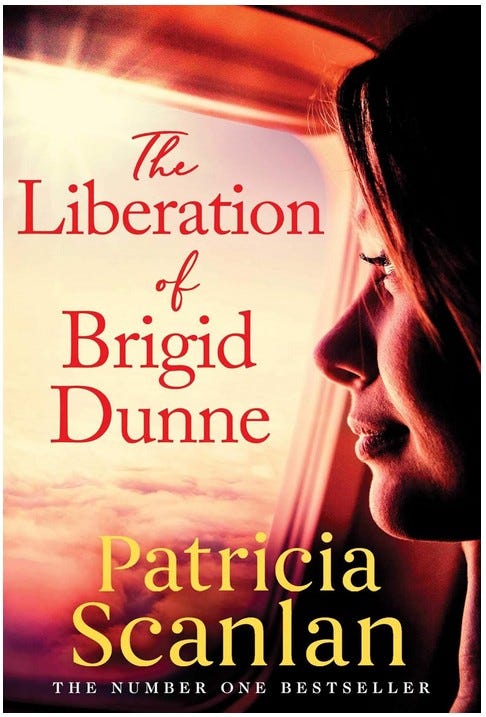
My reading tastes are quite varied, and I have curated my little library so that it contains something to cater to all my whims. Because for the past few months I had mostly read crime and mystery books, I felt the need for something else.
While browsing through my books I stopped at Patricia Scanlan’s ‘The Liberation of Brigid Dunne’, mainly because I felt the need for an Irish writer and an Irish story, plus a bit of a breather from investigating murders. More recently the book was published under the title ‘A Family Reunion’.
I found my copy of the book in a charity shop and I was over the moon to find a signed one. I love signed copies and have amassed quite a few from various writers I like.
At first, when I started the book I was a bit confused about the structure and the characters, but then, the more I read, it all started to make sense and it became very interesting.
I will not give too many details about the story, as I really want you to read it if you think it is for you, but I do have to touch on some points if I am to write my post about it.
The book revolves around four women and it spans over a long time, from the 1950ies to the 2000. It tells us about their experiences over time, what they faced, how they grew and transformed, shaped by the society they lived in and the expectations made on them.
Now, it is well known the impact the church had on the lives of women in Ireland ( and in many other places I am sure) and how women suffered being subjected to the strict rules of the church and society.
While reading the book, I could not help but think about how women in Romania also suffered during communism, particularly because of the regime’s emphasis on large families and population growth.
During the communist period it was illegal to use contraception or stop a pregnancy. In 1966 Nicolae Ceausescu introduced one of the harshest pronatalist policies in the world with Decree 770. The decree banned and made illegal stopping a pregnancy, eliminated access to contraception and framed reproduction as a duty to the state.
The aim was rapid demographic growth, as a larger population meant more workers and more power, women becoming essentially instruments of state policy. It went so far as women being subjected to mandatory gynecological exams at work, surveillance to detect pregnancy and it was illegal for doctors to assist with stopping pregnancies.
This led to a huge increase in unsafe procedures, thousands of maternal deaths were recorded and a rise in the numbers of abandoned children.
The full story and its details are horrible, and it is a generational trauma that is not spoken about. But we know.
I suppose that’s why Patricia Scanlan’s book resonated with me so strongly. The pressure of society and religion on women is not abstract to me, it’s something I recognize from the lives of the women in my own family, who lived under a system that enforced reproduction and denied them real choice. They had to navigate structures that rarely asked for consent, only obedience. If you did not obey the alternatives were jail or death.
I looked it up and sadly I see the book was not translated in Romanian, I think it would be a good seller in Romania, but it might just be me. Anyway, if anyone wants to publish it I would be more than happy to translate it, let me know.
The book is an interesting read even without the societal and religious interpretations, so I do not want to paint it as a dark novel. It is entertaining and it flows very well. You can see the care that went into it and that it is written by an experienced author. It is confident in tone and structure.
I recommend it as, for me, it strikes a great balance between introspective, informative, and entertaining. I really enjoyed it, and it made me reflect on things long buried, which is exactly what a good book should do.