


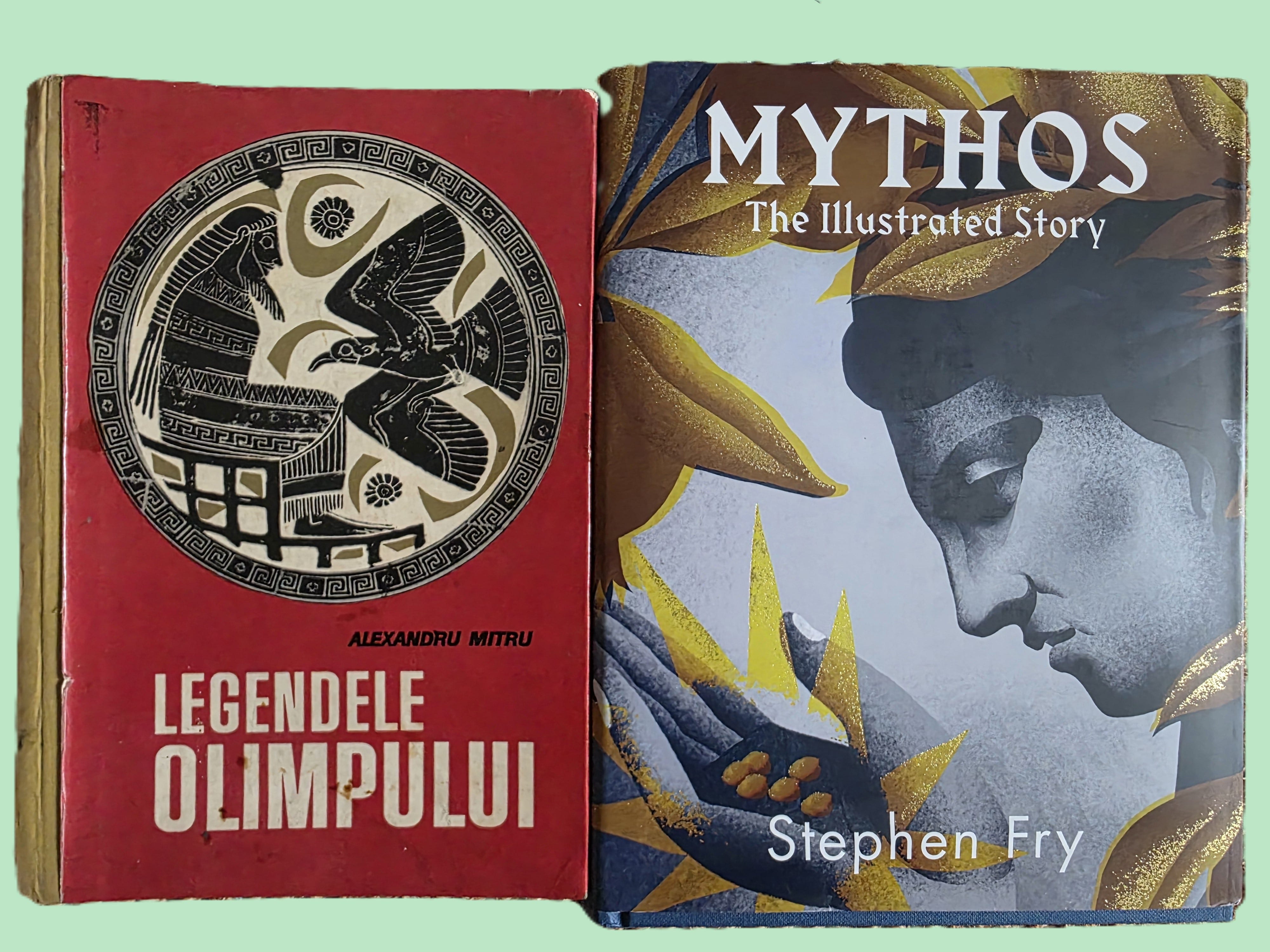
When I was around eleven or twelve, one of my teachers gave me to read an old edition of a book on Greek mythology. She let me have the book over the summer holidays, and I hold such fond memories of spending time reading the book on our bright balcony, somewhere in middle-Romania.
Sadly, I had to give the book back as it was a prized edition, but I always remembered it and the stories that filled that summer. I was over the moon when my wonderful better half actually managed to find it for me in an old books, bookshop a few years back. Now this is one of my most prized possessions.
Ever since those early years, I have loved mythology. The book I read that summer was The Legends of Olympus, written in the 1960s by the Romanian author Alexandru Mitru. In it, he retold the ancient myths in an engaging, easy-to-follow way, making them accessible to a whole new audience of young readers and story-loving adults.
The stories of the Gods and of the Heroes are wonderfully entertaining, and having them retold in a language that was easier to follow by modern audiences was, and is, a great accomplishment. Sometimes the events in the myths can be a bit too… much for young readers, but they were masterfully integrated by Mitru in the stories.
Reading Stephen Fry’s own retelling of the myths in Mythos made me think of the Romanian book, and although they are different works, from different eras separated by almost half a century, they both want to accomplish the same thing, make the myths accessible and current.
When I first started reading Stephen Fry’s retelling, I was a bit put off by the too colloquial references he made, but then the stories got so engaging that I kind of brushed over them.
I have lost count of the number of books I have about myths and mythology, stories from different countries, not just Greek, and I am fascinated by how some of them overlap and how very different peoples can have similar beliefs.
I was chatting with a colleague from Egypt, and by accident, I said another person’s name. I explained that in Romania, when you do that, we think that the person is thinking about you. My colleague said that it is the same thing in Egypt; they also believe that when you say somebody’s name by accident, it means that the person is thinking about you.
I found that fascinating, that a people from Southeastern and Central Europe would have the same old belief as the people of Egypt.
I loved stories a lot ever since I was a child, and even now, I love picking up a book of short stories, or legends or myths, and opening it at random and reading something new and unexpected, or something I had read before and forgot the details.
The myths will always hold a special fascination for me, though, because of their impact on our development and because they are part of our development.
I sometimes think about writing some stories with gods living nowadays (I have the same fantasy with witches, see My Mythology section), something along the lines of American Gods the TV series based on Neil Gaiman’s novel, but different of course. Maybe when the time comes that is something that I will do.
I was thinking about that today, about writing and how it seems everything was done, but what I can say for sure is that it wasn’t done by me, so it is worth having a crack at it! This and other projects, but I digress.
Mythology is great, and I think the biggest lesson we can learn from it is that humans have been humans for thousands of years, drawn and moved by the same things, made happy or miserable by the same events, loved, lost, feared, yearned … and that, when it comes to humans, we don’t really change, not nearly as much as we think anyway.